
The uncomfortable truth behind clean beauty lawsuits
Clean beauty brands are learning a hard lesson. Many of the lawsuits they fear most are not driven by bad intent. They’re triggered by optimistic language that feels reasonable in the moment, but proves fragile under scrutiny.
As the legal bar for what counts as “misleading” continues to rise, founders are discovering that clever copy does not protect them. In some cases, it creates exposure.
That reality came into focus during Phycus Biotechnologies’ latest Partners in Profit roundtable. Across the discussion, one idea surfaced repeatedly.
You can’t market your way out of legal risk. You have to design your way out of it.
When marketing stops being the hero
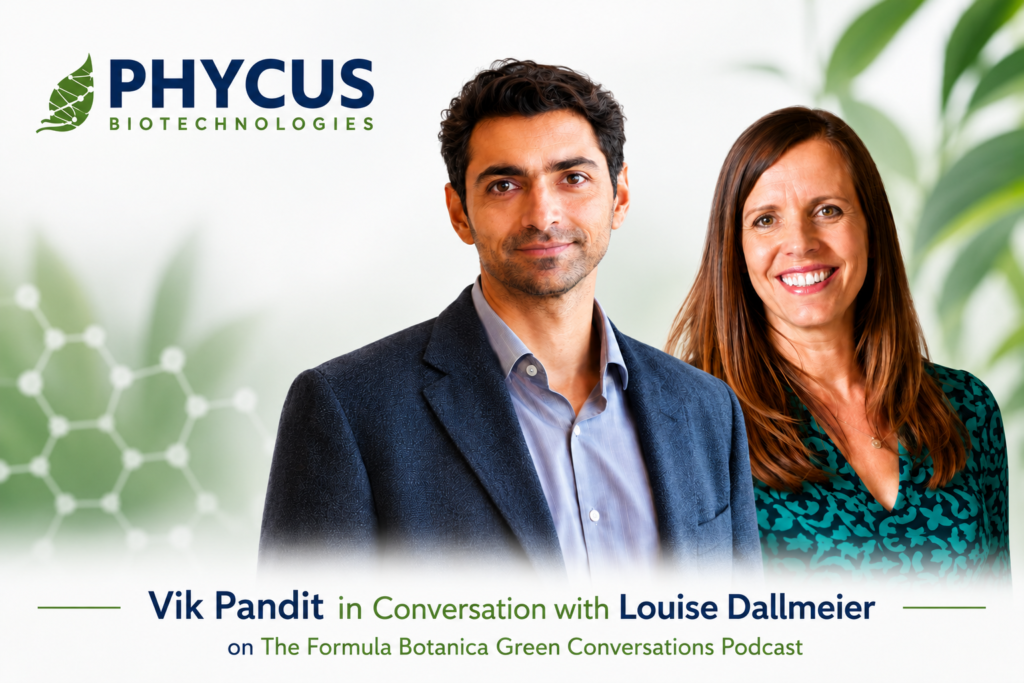
The session brought together operators, formulators, and founders. It was hosted by Don Frey, former CEO and President of the Independent Beauty Association, and featured consumer products regulatory attorney Angela Diesch, alongside Vik Pandit, founder of Phycus Biotechnologies.
It became clear that participants believed they were already making responsible choices. What surprised many of them was how often those choices – reflected as packaging or ad claims – created potential jeopardy.
“We need to be careful what we say” wasn’t the issue. “We need to be careful how things are built before we ever say anything” was.
The legal shift brands can’t ignore
As Diesch explained, fewer cases today hinge on claims that are outright false. More focus on statements that are technically true but open to interpretation.
That is where marketing language becomes vulnerable. Words like “natural,” “clean,” or “100%” are not illegal. They are ambiguous. Ambiguity is where legal exposure tends to live.
If a claim can be interpreted, it can be challenged.
The deeper issue isn’t intent. It’s relying on language to carry meaning that operations and documentation can’t always support.
The “100%” moment
One founder asked a question many brands quietly wrestle with. “If my product really is natural, can I say ‘100% natural’?”
The verdict? A single inconsistency can be enough to invite scrutiny. It’s not about finding safer words. It’s about narrowing claims to what can be structurally defended.
Differentiation still matters. It just can’t outrun proof.
Why packaging changes the risk equation
This is where packaging entered the conversation.
Frey drew a clear distinction. Advertising can be adjusted, but packaging can’t. When packaging claims rest on assumptions rather than documentation, brands inherit risk that is difficult to unwind. Once a claim is printed, it becomes far harder to correct.
Packaging is where optimism turns into liability.
At that point, disclaimers offer little protection. Only upstream rigor does.
The quiet defense hiding upstream
Some brands reduce legal exposure not by saying less, but by building more certainty earlier. Pandit described clean ingredients as a form of insurance. Not immunity, but insulation. Brands that adopt them thoughtfully are often better positioned when regulations tighten.
Certified and traceable ingredients came up not as marketing signals, but as risk dampeners. They anchor claims to recognized standards and limit interpretation.
Certifications reduce ambiguity. That alone changes the legal equation.
Where certifications can create new risk
Certifications and marketing claims are not the same thing. A material may be certified as 100% bio-based under a recognized standard. That means its carbon content is fully derived from renewable biological sources. It does not automatically justify a sweeping consumer-facing claim.
As Diesch emphasized, finished products are rarely free from trace contamination or environmental exposure. The risk is not in using certified ingredients. It lies in translating technical certifications into absolutes without context.
Pandit noted that this is why Phycus works closely with contract manufacturers, brands, and legal teams. The goal is not simply to supply certified bio-based ingredients. It is to ensure that claims built on those ingredients remain accurate, narrow, and defensible in real-world conditions.
One participant summed it up simply.
You don’t need to be perfect. You just need to avoid looking careless.
Ingredient innovation as legal architecture
Pandit’s discussion of glycolic acid was not framed as sustainability theater. It was framed as legal architecture. Glycolic acid is widely perceived as natural, yet most commercial supply remains petrochemical-derived. As transparency expectations rise, how an ingredient is made becomes inseparable from what a brand can safely imply.
When ingredient reality matches the story a brand wants to tell, language carries less burden.
How risk sneaks in after formulation
Risk often enters after formulation is complete. Ingredient substitutions that share the same INCI but differ in source or process can quietly undermine claims without a brand’s knowledge.
The solution is not tighter copy review, but stronger systems.
Legal risk rarely starts in marketing. It sneaks in through operations.
What this all adds up to
Clean beauty’s next phase will not be defined by louder claims. It will be shaped by how well brands reduce the gap between what a product truly is and what a claim implies. That gap is closed upstream.
What clean beauty issues are you facing? Drop us a line at sales@phycusbio.com.